
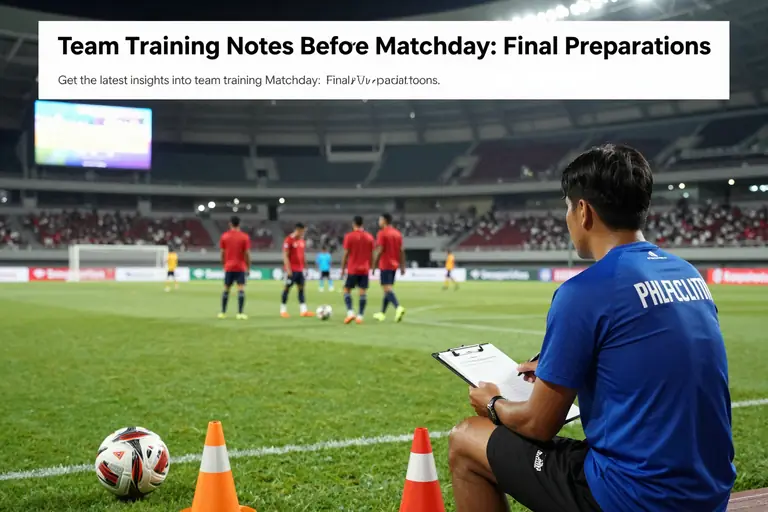
The Crucial Final Hours: Team Training Notes Before Matchday
As the clock ticks closer to kick-off, the final training sessions become a critical period for any football team. These aren’t just routine drills; they’re intense, focused preparations designed to fine-tune tactics, sharpen individual performances, and build collective confidence. We at our site understand the importance of these moments, and our coverage delves deep into what goes on behind the scenes.
The information gleaned from these sessions, often referred to as Team Training Notes Before Matchday, provides invaluable insights into a team’s potential approach, player availability, and overall readiness. Coaches and their staff meticulously plan every minute, ensuring that all aspects – from physical conditioning to mental fortitude – are addressed.
Tactical Tweaks and Formation Focus
One of the primary objectives of pre-matchday training is to solidify the tactical game plan. This often involves specific drills that simulate scenarios expected in the upcoming match. For instance, if a team is facing an opponent known for their high press, training might focus on quick ball circulation and breaking lines under pressure. Conversely, if the opposition is defensively solid, sessions could involve intricate attacking patterns and set-piece routines.
Coaches use this time to experiment with different formations or make subtle adjustments to their preferred system. A key player’s absence due to injury or suspension might necessitate a change in personnel, which in turn could lead to a shift in tactical setup. These changes are practiced repeatedly to ensure every player understands their role and responsibilities within the new framework. Communication, both verbal and non-verbal, is emphasized, as it’s vital for seamless execution on the pitch.
Player Fitness and Injury Updates
The health of the squad is always paramount, and the final training sessions are closely monitored for any signs of fatigue or potential injuries. Medical staff work hand-in-hand with the coaching team to assess each player’s physical condition. Players returning from injury are carefully integrated back into full training, with their progress tracked meticulously. Sometimes, a player might participate in light training but be deemed not ready for the intensity of a competitive match.
These updates are crucial for fans and pundits alike, as they directly impact team selection. A star player’s last-minute withdrawal can send ripples through the entire strategy. During these sessions, coaches also pay attention to the mental state of their players, ensuring they are motivated, focused, and free from undue pressure. Sometimes, a lighter session or a team-building exercise might be incorporated to boost morale.
Set-Piece Mastery: Corners, Free-Kicks, and Penalties
In modern football, set pieces often prove to be the difference-makers. Teams dedicate significant time during their pre-match training to perfect their attacking and defensive set-piece routines. This includes everything from corner kick strategies – who takes them, where the ball is delivered, and how players move to create space – to free-kick routines, both direct and indirect.
Defensively, players practice marking assignments and zonal responsibilities to prevent conceding from these crucial situations. Penalties are also rehearsed, especially if a match is expected to be tight or if it’s a cup tie that could go to a shootout. Goalkeepers often practice against different penalty takers to get a feel for their techniques. The precision and coordination required for effective set-piece execution are honed during these final sessions, making them a vital component of Team Training Notes Before Matchday.
Mental Preparation and Team Cohesion
Beyond the physical and tactical aspects, the final training sessions are also about mental preparation and strengthening team cohesion. Coaches often conduct team talks, emphasizing key messages and instilling belief in their players. Visualization exercises, where players mentally rehearse successful actions in the upcoming match, are also common.
The atmosphere in training can be a strong indicator of a team’s confidence. A buoyant, focused session often translates to a confident performance on matchday. Conversely, a sluggish or disjointed session might raise concerns. Building strong connections and mutual trust among players is critical, as football is a team sport where individual brilliance must be complemented by collective effort. Our Full Match Review: World Cup Action Today often highlights how well-drilled teams execute their plans under pressure, a direct result of meticulous training.
Final Walkthroughs and Opposition Analysis
The last training session often includes a final walkthrough of the opponent’s strengths and weaknesses. Coaches will use video analysis to highlight specific players or tactical patterns to watch out for. This ensures that every player is fully aware of what to expect and how to counter it. For example, if the opposition has a dangerous winger, the full-back and wide midfielder will be given specific instructions on how to contain them.
These walkthroughs are usually brief but incredibly detailed, serving as a final reminder of the game plan. It’s about reinforcing key messages and ensuring clarity, leaving no room for doubt or confusion once the whistle blows. This focused review helps players mentally prepare for the challenges ahead and allows them to visualize how they will implement their training on the field.
FAQ
What are “Team Training Notes Before Matchday”?
These are the observations, tactical adjustments, player fitness updates, and strategic focuses derived from a football team’s final training sessions leading up to a match.
Why are these notes important for fans?
They offer insights into a team’s likely formation, player availability (injuries/suspensions), tactical approach, and overall readiness, helping fans better understand the upcoming game.
Do coaches change tactics based on these notes?
Yes, coaches often use the final training sessions to fine-tune tactics, experiment with formations, or make last-minute adjustments based on player performance, fitness, or opposition analysis.
How do teams prepare for set pieces during these sessions?
Teams dedicate significant time to practicing attacking and defensive set-piece routines, including corners, free-kicks, and penalties, as these can be crucial in deciding a match’s outcome.